How to Make a Budget in 6 Steps (With Real Examples)
In this article
- Step 1: Figure out your monthly take-home pay
- Step 2: Track where your money is going now
- Step 3: Sort your expenses
- Step 4: Choose a budgeting method
- Step 5: Build your budget (a real example)
- Step 6: Track it and review it every month
- Tools: spreadsheet or app?
- Common budgeting mistakes
- Frequently asked questions
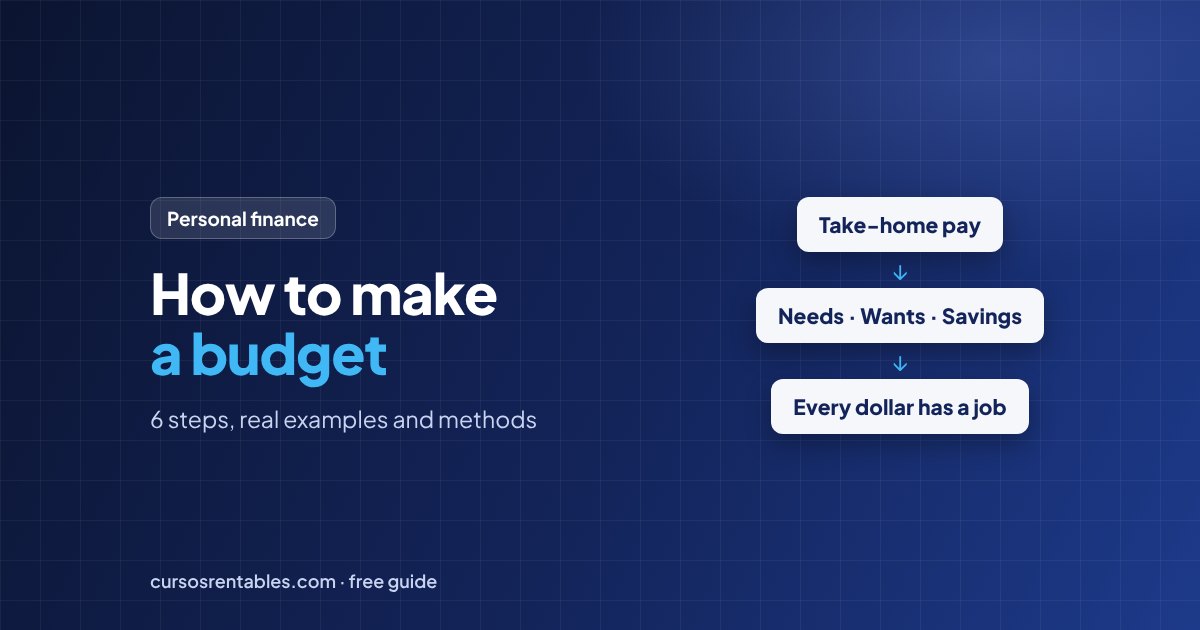
To make a budget, start with your monthly take-home pay, list everything you spend, sort those expenses into needs, wants and savings, pick a budgeting method, and give every dollar a job before the month begins. Then check in once a week and adjust once a month. That's it: a budget is simply a plan for your money, made before the money is gone.
This guide walks you through each step with real numbers, compares the most popular budgeting methods, and shows you the mistakes that make most people quit by February.
Step 1: Figure out your monthly take-home pay
Budget with your net income: the money that actually lands in your checking account after taxes, health insurance premiums and retirement contributions come out of your paycheck. Your salary on paper (gross income) is not the number you can spend.
- Paid every two weeks? You get 26 paychecks a year, not 24. Budget with two paychecks a month and treat the two "extra" paychecks as a bonus for savings or debt.
- Paid twice a month? Add both paychecks.
- Freelancer, gig worker or on commission? Average your last 6 to 12 months and budget with your lowest typical month. Anything above that goes to a buffer first. If you're self-employed, also set aside money for taxes, since nobody withholds them for you.
Step 2: Track where your money is going now
You can't plan your spending until you know your spending. The fastest way: download the last 2 or 3 months of transactions from your bank and credit card accounts and add them up by category. Most people are surprised by two things: how much goes to food (groceries plus takeout) and how many small subscriptions they still pay for.
While you're scanning your statements, highlight every recurring charge. Canceling just two or three forgotten subscriptions is often the easiest money you'll ever "make."
Step 3: Sort your expenses
Fixed expenses
Same amount every month: rent or mortgage, car payment, insurance, phone plan, minimum debt payments.
How to manage them: shop around once a year. Lowering one fixed bill saves money every month without any willpower.Variable expenses
Change month to month: groceries, gas, utilities, household items.
How to manage them: set a monthly limit and check it weekly.Discretionary spending
Dining out, entertainment, shopping, hobbies, travel.
How to manage them: this is where your flexibility is. Keep what you love, cut what you won't miss.Don't forget irregular expenses
Car insurance paid every six months, holiday gifts, annual subscriptions and car registration are the expenses that "break" a budget. They're not surprises; they're just not monthly. Add up what they cost in a year, divide by 12 and set that amount aside every month in a separate savings account:
| Irregular expense | Per year | Per month (÷ 12) |
|---|---|---|
| Car insurance ($720 every six months) | $1,440 | $120 |
| Holiday and birthday gifts | $600 | $50 |
| Annual subscriptions | $180 | $15 |
| Car registration | $120 | $10 |
| Total | $2,340 | $195 |
Step 4: Choose a budgeting method
There's no single "right" method. The best one is the one you'll still be using six months from now.
The 50/30/20 rule
Popularized by Elizabeth Warren and Amelia Warren Tyagi in their book All Your Worth, the 50/30/20 rule splits your take-home pay into three buckets: 50% for needs, 30% for wants and 20% for savings and extra debt payments. Here's what it looks like with $4,000 a month:
- Needs (50%) $2,000Housing, utilities, groceries, transportation, insurance, minimum debt payments.
- Wants (30%) $1,200Dining out, streaming, shopping, hobbies, travel.
- Savings and debt (20%) $800Emergency fund, retirement, extra payments on high-interest debt.
Zero-based budgeting
You assign every dollar of income to a category until income − spending − saving = $0. It doesn't mean you spend everything; savings is one of the categories. It takes more effort but gives you the most control, which is why it's popular with people paying off debt.
The envelope method
You put a fixed amount in an "envelope" for each variable category, like groceries or entertainment. When an envelope is empty, that spending stops until next month. People used to do it with cash; today many banks let you create savings "buckets" or sub-accounts that work the same way.
Pay yourself first
Also called a reverse budget: the day you get paid, an automatic transfer sends a set amount to savings and investments. You can spend the rest however you want, as long as the bills get paid. It's the lowest-effort method and works well if you're not overspending.
- Effort
- ●●●●
- Control
- ●●●●
- Best for
- Your first budget.
- Effort
- ●●●●
- Control
- ●●●●
- Best for
- Tight budgets and paying off debt.
- Effort
- ●●●●
- Control
- ●●●●
- Best for
- Overspending in the same categories.
- Effort
- ●●●●
- Control
- ●●●●
- Best for
- Disciplined spenders who hate tracking.
Step 5: Build your budget (a real example)
Maya takes home $4,200 a month. She used a zero-based budget, so every dollar is assigned and the total adds up to exactly her income:
| Category | Type | Monthly amount |
|---|---|---|
| Rent | Need | $1,350 |
| Groceries | Need | $500 |
| Car payment | Need | $380 |
| Student loan (minimum) | Need | $250 |
| Utilities | Need | $180 |
| Car and renters insurance | Need | $165 |
| Gas | Need | $160 |
| Irregular expenses fund | Need | $120 |
| Phone | Need | $70 |
| Dining out | Want | $220 |
| Clothing and personal | Want | $150 |
| Streaming and fun | Want | $85 |
| Emergency fund | Savings | $400 |
| Roth IRA | Savings | $170 |
| Total | $4,200 |
Her needs come to $3,175 (75.6%), wants $455 (10.8%) and savings $570 (13.6%). She's nowhere near 50/30/20, and that's fine: she already keeps her wants low, and she still saves every month. The budget also tells her where the real lever is. Rent and the car payment eat $1,730 a month. A cheaper apartment at her next lease renewal, or refinancing the car, would do more than giving up every dinner out.
Step 6: Track it and review it every month
A budget only works if you look at it. Here's a routine that takes less than an hour a month:
- PaydayAutomate savings firstSchedule transfers to savings and retirement for the day your paycheck arrives.
- Every week · 10 minCategorize your transactionsUse your bank app, a budgeting app or a spreadsheet. Fix anything that's miscategorized.
- Mid-monthCheck your variable categoriesIf groceries or dining out are already at 70%, slow down now instead of finding out on the 31st.
- End of month · 20 minReview and adjustCompare planned vs. actual and set next month's numbers.
Your end-of-month checklist:
Tools: spreadsheet or app?
Both work. A free Google Sheets or Excel spreadsheet gives you full control and costs nothing; you just need to import or type your transactions. If you'd rather automate, budgeting apps connect to your bank and categorize spending for you. Some, like YNAB or EveryDollar, are built around zero-based budgeting. Pick the tool you'll actually open every week.
A simple spreadsheet only needs two tabs: a Transactions tab (date, description, category, amount) and a Budget tab where the "actual" column adds up each category automatically:
=SUMIFS(Transactions!D:D, Transactions!C:C, A2)Common budgeting mistakes
Building a "perfect" budget that looks nothing like your real spending.
Start from last month's real numbers and adjust a little at a time.
Saving whatever is left at the end of the month.
Save first, automatically, on payday.
Forgetting irregular expenses.
Divide them by 12 and set that amount aside every month.
Quitting after the first month you overspend.
Overspending is data. Adjust the category and keep going.
Cutting every fun expense at once.
Keep a small "fun money" line. Budgets with zero room for enjoyment don't last.
Frequently asked questions
What is the easiest way to start a budget?
Use the 50/30/20 rule with last month's bank statement. You can set it up in about 30 minutes and switch to a more detailed method later if you need more control.
Should I budget with my gross or net income?
Net income, the amount that actually reaches your account. Your gross salary includes money you never get to spend, like taxes and benefit deductions.
How much should I save each month?
20% of take-home pay is a common target. If that's not realistic yet, start with 5% or 10% and raise it each time you get a raise or pay off a debt. Building an emergency fund of three to six months of essential expenses is usually the first priority.
How do I budget with an irregular income?
Budget with your lowest typical month, not your average. In good months, put the extra into a buffer account and "pay yourself" a steady amount from it in slow months.
How often should I review my budget?
Check transactions weekly (10 minutes) and do a full review once a month. Revisit your fixed expenses once a year.
Your budget will also tell you where your credit card balances are coming from. If debt is part of your picture, read our guide on how to improve your credit score next.
Want to go further, from budgeting to investing? Browse our free personal finance course, with 16 step-by-step lessons, exercises and a budget template.
Keep reading
 How to Improve Your Credit Score: 10 Steps That Work
The fastest ways to improve your credit score are to pay every bill on time, lower the sh…
 Debits and Credits Explained: Rules, Examples and Cheat Sheet
In accounting, a debit is an entry on the left side of an account and a credit is an entr…
 Bookkeeping for Small Business: A Beginner's Guide
Bookkeeping for a small business means recording every dollar that comes in and goes out,…