100% free Certificate included Downloadable templates

Free Bookkeeping & Accounting Course

Learn bookkeeping and accounting by following one U.S. small business from day one, from debits and credits to financial statements, taxes, payroll and business valuation.

  • 16lessons
  • 3h 3minof reading
  • 64review questions
  • 16worked exercises

No sign-up needed: just start reading. Create a free account to save your progress and get your certificate.

What you’ll learn

  • What accounting is and why profit isn't the same as cash
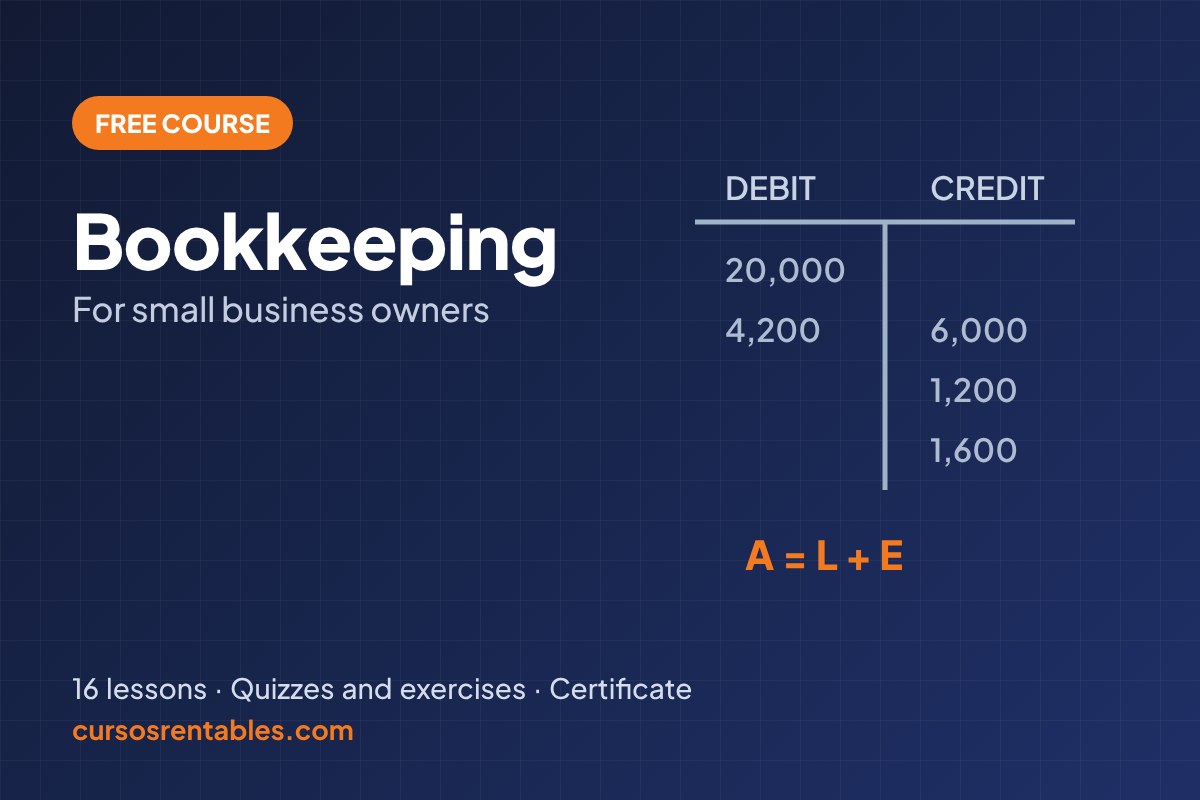
  • The accounting equation: assets, liabilities and owner's equity
  • How to set up a chart of accounts that maps to your tax return
  • Debits and credits, and how to write balanced journal entries
  • The general journal, general ledger, trial balance and bank reconciliation
  • Inventory costing with FIFO, LIFO and weighted average
  • Adjusting entries, accruals and closing the books
  • How to build and read an income statement and find your break-even point
  • How to read a balance sheet and calculate working capital
  • The cash flow statement and key financial ratios, including DSCR
  • How to build a business budget and a cash budget, and analyze variances
  • Financial statement analysis with EBITDA and the DuPont model
  • How sales tax, income tax and self-employment tax work for U.S. small businesses
  • Forms W-9, 1099-NEC and W-2, and quarterly estimated taxes
  • The true cost of an employee: FICA, FUTA, SUTA, workers' comp and benefits
  • How to calculate product cost and set prices with the right margin
  • How to value a business with DCF and EV/EBITDA multiples
A clear goal

Every lesson starts by telling you what you’ll be able to do.

Real examples

Real-life cases from U.S. households and small businesses.

Instant quizzes

Check what you learned with immediate feedback.

Worked exercise

Practice first, then compare with the solution.

Course syllabus

4 levels · 16 lessons · 3h 3min of content

1 Level 1Beginner 4 lessons · 47 min
  1. 1
    What Is Accounting? Why It Matters Even If You're Not an Accountant

    Bookkeeping vs. accounting, the branches of accounting, the core GAAP principles and the accounting cycle, introducing Brightside Coffee.

    14 min
  2. 2
    The Accounting Equation: Assets, Liabilities and Equity, with Examples

    Assets = Liabilities + Equity: what each element is and how every transaction, draw and sale affects it.

    11 min
  3. 3
    Accounts and the Chart of Accounts

    The accounts small businesses use most, how to number a chart of accounts that maps to your tax return, and straight-line depreciation.

    11 min
  4. 4
    Debits and Credits: Double-Entry Bookkeeping with Examples

    The debit and credit rules, how to write balanced journal entries and compound entries with sales tax and loan payments.

    11 min
2 Level 2Intermediate 4 lessons · 45 min
  1. 5
    The Journal, the General Ledger and the Trial Balance

    How to record, post to the ledger, make the first adjusting entry, prepare a trial balance and reconcile the bank.

    11 min
  2. 6
    Inventory and Cost of Goods Sold: FIFO, LIFO and Weighted Average

    Perpetual and periodic systems, inventory entries, FIFO, LIFO and weighted average costing, the LIFO conformity rule, turnover and shrinkage.

    12 min
  3. 7
    Adjusting Entries and Closing the Books

    Prepaid and accrued items, unearned revenue and gift cards, bad debt allowances, closing entries with income summary and a month-end checklist.

    11 min
  4. 8
    The Income Statement (Profit and Loss) and Break-Even Point

    Multi-step P&L structure, margins, vertical analysis, how taxes appear by entity type, fixed and variable costs and the break-even point.

    11 min
3 Level 3Advanced 4 lessons · 42 min
  1. 9
    The Balance Sheet: How to Build It and How to Read It

    Classified balance sheet, owner's and stockholders' equity, working capital, the cash conversion cycle and common small business mistakes.

    11 min
  2. 10
    The Cash Flow Statement and Financial Ratios

    Direct and indirect methods, liquidity, leverage and profitability ratios, the debt service coverage ratio and a monthly review checklist.

    11 min
  3. 11
    Business Budgeting and Budget vs. Actual Analysis

    The master budget, budgeted income statement, cash budget with draws and taxes, variance analysis and flexible budgets.

    10 min
  4. 12
    Financial Statement Analysis: Horizontal, Vertical, EBITDA and DuPont

    Year-over-year analysis, EBITDA, net debt to EBITDA, interest coverage, the DuPont model, the cash conversion cycle and red flags.

    10 min
4 Level 4Expert 4 lessons · 49 min
  1. 13
    Small Business Taxes in the U.S.: Sales Tax, Income Tax, Self-Employment Tax and 1099s

    State and local sales tax, nexus, taxation by entity type, self-employment tax, estimated taxes, book vs. taxable income, W-9 and 1099-NEC.

    14 min
  2. 14
    The True Cost of an Employee: Payroll Taxes, Benefits and Payroll Entries

    Gross pay, net pay and employer cost, FICA, FUTA, SUTA, workers' comp and benefits, payroll journal entries, cost per billable hour and worker classification.

    12 min
  3. 15
    Cost Accounting: How to Calculate Product Cost and Set Your Prices

    Direct materials, direct labor and overhead, absorption vs. variable costing, overhead allocation, markup vs. margin and keystone pricing.

    11 min
  4. 16
    Business Valuation: Discounted Cash Flow (DCF) and Multiples

    Free cash flow, WACC, terminal value, net debt, EV/EBITDA and SDE multiples, and sensitivity analysis to estimate what a business is worth.

    12 min

About this course

A practical bookkeeping and accounting course for small business owners, freelancers, managers and anyone who needs to understand a business's numbers without becoming a CPA. No prior knowledge required, and every concept comes with a worked example in dollars.

You'll follow Brightside Coffee, a small coffee shop in Austin, Texas, from its first day: you'll record its transactions with double-entry bookkeeping, build its journal, general ledger and trial balance, and prepare its income statement, balance sheet and cash flow statement. Then you'll move on to inventory (FIFO, LIFO and weighted average), adjusting and closing entries, budgeting and financial analysis with EBITDA and DuPont, and finish with what owners ask about most: U.S. sales tax and income tax, self-employment tax and 1099s, the true cost of an employee, product costing and pricing, and what a business is worth. It's 16 lessons in four levels, with interactive quizzes and solved exercises. The content is educational and isn't tax or legal advice.

Includes a free downloadable template: a bookkeeping spreadsheet for Excel or Google Sheets with a chart of accounts, a journal, a trial balance and an income statement and balance sheet that calculate themselves.
Downloadable resources

Templates and practice data you’ll use throughout the course. Free, no sign-up.

  • XLS bookkeeping-template.xlsx26 KB Download

Frequently asked questions

Do I need any accounting background?
No. The course starts from zero and is designed for people who aren't accountants: small business owners, freelancers, students in other fields, managers and investors. Each lesson builds on the previous one with examples in dollars.
Will this course teach me to do my own small business bookkeeping?
Yes. You'll learn to record transactions, reconcile accounts, close the month and read your financial statements. Tax filing rules change and depend on your state and business structure, so for tax returns it's wise to work with a CPA or enrolled agent. The course is educational and isn't tax or legal advice.
Does it follow U.S. GAAP and IRS rules?
Yes. The examples follow U.S. GAAP concepts and use IRS forms such as Schedule C, W-2, W-9 and 1099-NEC. Figures that change every year, like the 2026 Social Security wage base or the 1099-NEC thresholds for 2025 and 2026, are labeled with the year they apply to.
Does it help if I use QuickBooks, Xero or Wave?
Yes. Accounting software automates posting and reports, but you still need to categorize transactions correctly and understand what the reports say. This course teaches the logic behind the software, and the downloadable template lets you practice in Excel or Google Sheets.
Is the course free, and do I get a certificate?
Yes. All 16 lessons are free and you can read them without signing up. If you create a free account, you can track your progress and download a certificate when you complete the course.