Agile vs Waterfall: Key Differences and When to Use Each
In this article
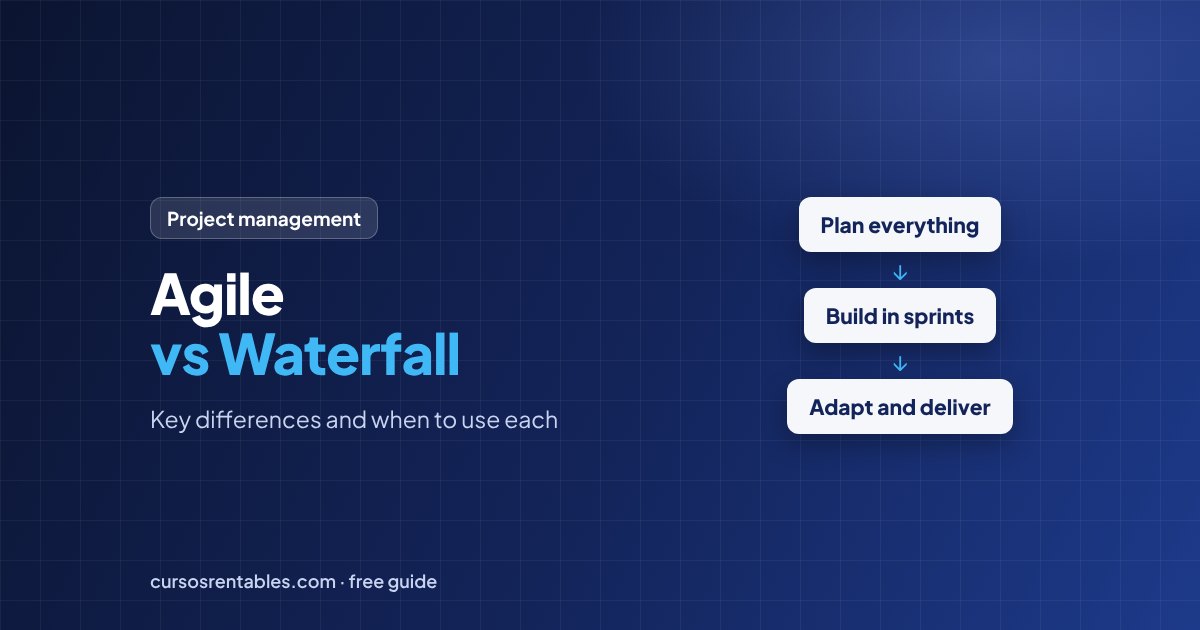
The difference between agile and waterfall comes down to when you plan and when you deliver. Waterfall plans the whole project up front and moves through fixed phases in order (requirements, design, build, test, launch), delivering the finished product once, at the end. Agile plans in short cycles, usually one to four weeks long, delivers a working piece of the product in every cycle and changes the plan based on feedback. Use waterfall when the requirements are clear and changing your mind is expensive. Use agile when the requirements are uncertain and change is cheap. If your project has a bit of both, you're in good company: many business projects end up hybrid.
This guide explains how each approach works, compares them side by side, runs the same project both ways so you can see the difference, and gives you a five-question test to pick the right approach for your next project.
What is the waterfall methodology?
Waterfall is a sequential, plan-driven way to run a project. Each phase has to be finished and approved before the next one starts, so the work "flows" down from one phase to the next like water over a series of steps. Project managers also call it the predictive or traditional approach, because the goal is to predict scope, schedule and cost before the real work begins.
- Phase 1RequirementsDocument everything the final product must do and get the sponsor or client to sign off.
- Phase 2DesignTurn the requirements into blueprints, specs or mockups. From here on, changes start to get expensive.
- Phase 3BuildThe team produces the work, following the approved design and the baseline schedule.
- Phase 4TestCheck the product against the Phase 1 requirements. Defects found here can send work back up the waterfall.
- Phase 5Deploy and closeHand over the finished product, get formal acceptance and move into maintenance.
Waterfall uses the tools most people picture when they hear "project management": a detailed scope, a work breakdown structure, a Gantt chart with task dependencies, a baseline budget and a formal change control process. Progress is measured against that baseline: are we on schedule and on budget?
Where it shines: predictability. Everyone knows the scope, the date and the price before work starts, which makes waterfall easy to contract, budget and coordinate with outside vendors. Where it hurts: late feedback. The customer often sees the real product for the first time near the end, exactly when fixing a misunderstanding costs the most.
What is agile project management?
Agile is an iterative way to deliver work. Instead of one big release, the team builds the product in small, usable increments and adjusts the plan after each one. It started in software: in 2001, a group of developers published the Manifesto for Agile Software Development, which values individuals and interactions, working software, customer collaboration and responding to change more than processes and tools, comprehensive documentation, contract negotiation and following a plan. Notice the "more than." Agile doesn't mean no plan and no documents. It means smaller plans, revisited often.
Agile is a set of values and principles, not a single method. The two frameworks you'll meet most often are:
- Scrum: a small, self-managing team works in fixed-length sprints of one month or less (two weeks is a popular choice). A Product Owner orders the backlog, a Scrum Master coaches the team, and every sprint ends with a working increment that stakeholders review. Our lesson on agile and Scrum walks through the roles, events and artifacts.
- Kanban: no sprints at all. Work flows continuously across a board (To do, Doing, Done), and the team caps how many items can be in progress at once so work actually gets finished. See Kanban boards, WIP limits and flow metrics.
Where it shines: learning fast. Users see working pieces early, so bad ideas die cheaply and good ones get more investment. Where it hurts: predictability. A sponsor who needs a fixed scope, date and price on day one will find pure agile uncomfortable, and the whole approach depends on a customer or product owner who's genuinely available.
Agile vs waterfall: side-by-side comparison
| Waterfall (predictive) | Agile | |
|---|---|---|
| Planning | Detailed plan up front for the whole project | High-level roadmap; detailed plan only for the next cycle |
| Requirements | Fixed and signed off early | Discovered and refined as you go |
| Delivery | Once, at the end | Every cycle, in small working increments |
| Handling change | Formal change requests; late changes are costly | Expected; the backlog is reordered every cycle |
| Customer involvement | Heavy at the start and at the end | Continuous, every cycle |
| What's fixed | Scope; time and cost are estimated from it | Time and team; scope flexes to fit |
| Measuring progress | Percent complete vs. the baseline schedule and budget | Working product delivered, plus velocity or flow metrics |
| Testing | A separate phase near the end | Built into every cycle |
| Documentation | Extensive, written before building | Just enough, updated as the product evolves |
| Team | Specialists hand work from phase to phase; the PM assigns tasks | Small cross-functional team that decides how to do the work |
| Biggest risk | Building the wrong thing and finding out late | Scope creep and fuzzy end dates without discipline |
The row that matters most is what's fixed. Waterfall locks the scope and estimates the time and money needed to deliver it. Agile flips that: it locks the time (the sprint) and the team, then delivers as much of the most valuable scope as fits. Neither approach escapes trade-offs. They just protect different things.
The same project, run both ways
Here's an illustrative example. Copper Kettle Coffee, a fictional chain with eight cafés in the Midwest, wants a mobile ordering app. The budget is $120,000 and the owners hope to launch in about six months.
The waterfall version. The team spends six weeks writing requirements: menu browsing, ordering, payments, a loyalty program, gift cards and pickup time slots. Design takes another month, development three months and testing four weeks. Customers touch the app for the first time at launch, in month six. Two weeks later, the data shows that most people simply reorder their usual drink, and almost nobody uses the gift card feature that took five weeks to build.
The agile version. The team works in two-week sprints. By week six, a bare-bones app lets staff and a handful of regulars at one café reorder their usual drink and pay. Their feedback reshapes the backlog: "reorder my usual" moves to the top and gift cards drop to the bottom. By month four the app is live in all eight cafés. By month six it has loyalty points, and gift cards are still waiting in the backlog because nobody is asking for them.
| Question | Waterfall | Agile |
|---|---|---|
| When do real customers first use it? | Month 6 | Week 6 (one café) |
| When is the full scope known? | Week 6, in writing | Never in full; it's reordered every sprint |
| What did the $120,000 buy? | Every feature in the spec, including some nobody uses | The most-used features first; low-value ones still waiting |
| How firm is the plan on day one? | Very firm, on paper | The date and budget are firm; the feature list isn't |
Agile clearly fits this app better: the requirements were educated guesses, and software is cheap to change. Now imagine the same chain opening a ninth café. You can't iterate on a building permit or pour half a foundation to see if customers like it. That project needs waterfall.
Waterfall, agile or hybrid: which one fits?
- Predictability
- ●●●●
- Flexibility
- ●●●●
- Best for
- Construction, events, equipment installs, regulated and fixed-price work.
- Predictability
- ●●●●
- Flexibility
- ●●●●
- Best for
- Software, digital products, content and marketing experiments.
- Predictability
- ●●●●
- Flexibility
- ●●●●
- Best for
- Business projects with a fixed date or budget and flexible features.
When to use waterfall
- The requirements are clear, stable and can be written down before you start.
- Changing your mind halfway is expensive or impossible: concrete, hardware, print runs, signed venue contracts.
- A contract, regulator or auditor expects a fixed scope, formal documentation and sign-offs at each stage.
- The work must happen in a strict order, with handoffs between vendors or trades.
- The customer won't be available for regular feedback once the work begins.
When to use agile
- Users can't fully describe what they want until they see something working.
- You can release, test or pilot the product in pieces.
- Someone with decision authority can review the work every week or two.
- Getting something useful to market soon matters more than shipping every feature on day one.
- The team is small enough to plan together and decide how to do the work.
How to choose: a 5-question test
Check every statement that's true for your project:
4–5 checked: go agile. 2–3 checked: use a hybrid, with a fixed frame and iterative work inside it. 0–1 checked: waterfall will serve you better, so invest in a solid plan up front.
Ask: "What does it cost us to change our minds halfway through?" If the answer involves tearing something down, plan more up front. If it involves editing a file, deliver small pieces and learn from real users.
How hybrid projects work in practice
Hybrid isn't doing half of each method badly. It means deciding, on purpose, which parts of the project need a fixed plan and which parts benefit from iteration. Three patterns show up again and again:
- Plan the frame, iterate inside it. The budget, launch date and major milestones live in a Gantt chart, while the product work inside each milestone runs in sprints. Copper Kettle could agree on the launch date and budget with its owners, then let the app team work in two-week sprints.
- Split by workstream. Physical or contractual work (hardware, construction, vendor agreements) runs waterfall; software, content and marketing run agile. Both sides meet at shared milestones.
- Stage gates with sprints. Leadership releases funding at each gate (concept, pilot, rollout) based on working results instead of documents.
What makes hybrid work is a single source of truth: one roadmap that shows the fixed milestones and the current sprint goals side by side, and one change process that everyone understands. The lesson on what project management is shows a small bakery using exactly this mix: a fixed festival date, with the online ordering pages refined week by week.
Common mistakes
Calling a project agile while locking every feature, date and dollar on day one.
If the scope can't flex, be honest that it's waterfall or hybrid, and say clearly what's fixed.
Using agile as an excuse to skip planning and documentation.
Agile still needs a product goal, an ordered backlog, a definition of done and enough documentation for the next person.
Running a waterfall software project that no user has seen until launch.
Add clickable prototypes or a small pilot so users react before the big build.
Running sprints without a real product owner.
Name one person who can set priorities and is available every sprint, or the team ends up guessing.
Judging an agile team by percent complete against a plan written six months ago.
Track working product delivered and outcomes, and update the forecast every sprint.
Frequently asked questions
What is the main difference between agile and waterfall?
Waterfall plans everything up front and delivers once at the end, moving through phases in a fixed order. Agile plans and delivers in short cycles, adjusting the plan after each one based on feedback.
Is agile better than waterfall?
Not in general. Agile is better when requirements are uncertain and change is cheap, as with software and digital products. Waterfall is better when requirements are stable and change is expensive, as with construction or regulated work. Many projects do best with a hybrid.
Is Scrum the same as agile?
No. Agile is a set of values and principles; Scrum is one framework for putting them into practice, with sprints, defined roles and regular events. Kanban is another agile approach that uses continuous flow instead of sprints.
Can agile work with a fixed budget and deadline?
Yes. Fix the time and the cost, and let the scope flex. The team delivers the highest-priority features first, so when the money or the calendar runs out, what's been built is the most valuable part.
Is waterfall outdated?
No. It's still the right choice when the work has to happen in sequence and mistakes are costly to undo, which is why construction, manufacturing and many government contracts rely on it. It's only "outdated" when it's used for work that's full of unknowns.
Whichever approach you choose, projects succeed or fail on people: how clearly you communicate, delegate and make decisions. Read our guide to the 10 essential leadership skills next.
Learn to run projects both ways, from Gantt charts and the critical path to Scrum and Kanban, in our free project management course, with 16 lessons, quizzes and a free Excel template.
Keep reading
 How to Make a Budget in 6 Steps (With Real Examples)
To make a budget, start with your monthly take-home pay, list everything you spend, sort …
 How to Improve Your Credit Score: 10 Steps That Work
The fastest ways to improve your credit score are to pay every bill on time, lower the sh…
 Debits and Credits Explained: Rules, Examples and Cheat Sheet
In accounting, a debit is an entry on the left side of an account and a credit is an entr…