What Is Digital Marketing? Types, Examples and How to Start
In this article
Digital marketing is promoting a business, product or service through online channels: search engines, social media, email, websites, online ads and content like videos, blogs and podcasts. Its big advantage over traditional marketing is that almost everything is measurable, so you can see which actions bring customers and invest more in what works.
In this guide you'll find the main types of digital marketing explained in plain English, the key metrics with worked examples, a simple 90-day plan for a small business, and how to start learning if you want a career in the field.
Digital vs. traditional marketing
| Traditional marketing | Digital marketing | |
|---|---|---|
| Examples | TV, radio, print, billboards, direct mail | Search, social media, email, online ads, content |
| Minimum budget | Usually high | Can start with very little, or just time |
| Targeting | Broad (a city, a TV audience) | Precise (interests, searches, location, past visitors) |
| Measurement | Estimated | Clicks, sales and costs tracked in detail |
| Changes | Slow and expensive | You can test and adjust the same day |
Most businesses use a mix of both, but for small businesses and new brands, digital is usually the most affordable way to reach the right people.
The main types of digital marketing
SEO
Search engine optimization: improving your website so it shows up in Google's free (organic) results.
Slow to start, but traffic keeps coming without paying per click.Content marketing
Useful articles, videos, guides and podcasts that attract and educate your audience.
Feeds SEO, social media and email.Social media marketing
Building an audience and community on Instagram, TikTok, Facebook, LinkedIn, YouTube and more.
Pick the one or two platforms where your customers really are.Paid search (PPC)
Ads on Google or Bing that appear when people search for specific terms. You pay per click.
Fast results for people already looking to buy.Paid social
Ads on Meta (Facebook and Instagram), TikTok, LinkedIn and other networks, targeted by interests and demographics.
Great for creating demand and retargeting visitors.Email marketing
Newsletters, welcome series, promotions and automated messages to people who opted in.
You own the list: no algorithm decides who sees your message.Affiliate marketing
Partners promote your products and earn a commission on each sale they bring.
You pay only for results.Influencer marketing
Working with creators whose audience matches your customers.
Micro-influencers often bring better engagement per dollar.The digital marketing funnel
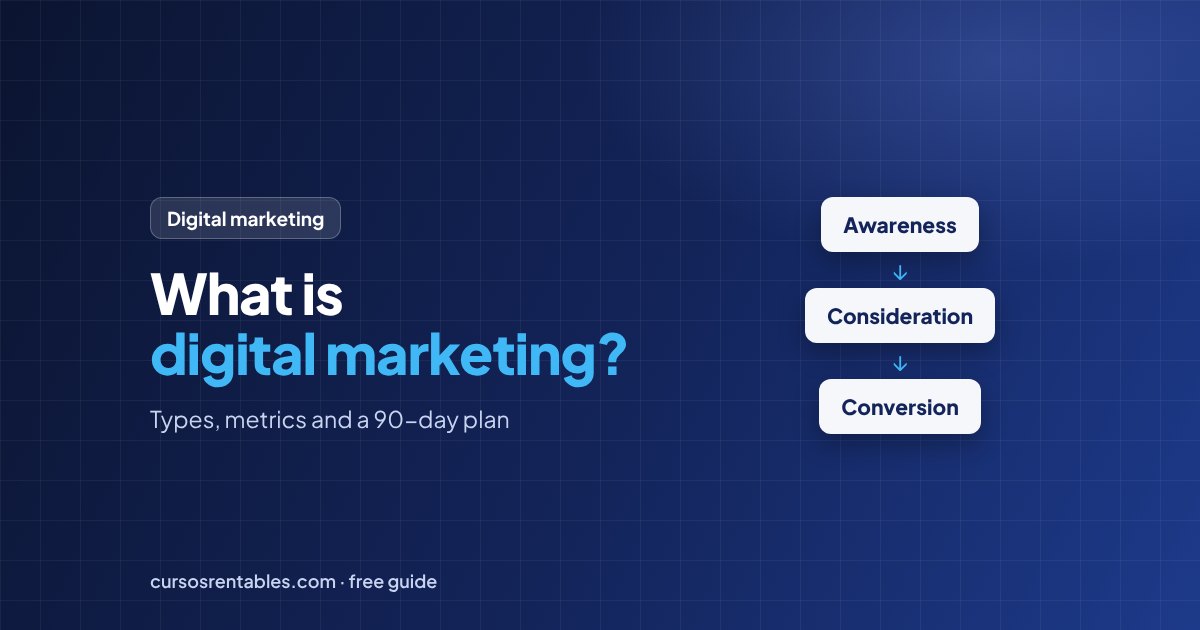
People rarely buy the first time they hear about you. A funnel maps the journey and tells you which channels and metrics matter at each stage:
| Stage | Goal | Typical channels | What to measure |
|---|---|---|---|
| Awareness | Get discovered | Social media, video, SEO content, paid social | Reach, impressions, video views |
| Consideration | Earn trust and interest | Blog, email newsletter, reviews, retargeting | Website visits, time on page, email sign-ups |
| Conversion | Get the sale or lead | Paid search, landing pages, email offers | Conversion rate, cost per acquisition |
| Retention | Bring them back | Email, loyalty programs, customer support, community | Repeat purchases, customer lifetime value |
Key metrics, with a worked example
A small online store spends $500 on an ad campaign. The ads get 50,000 impressions and 1,000 clicks, which lead to 40 sales worth $2,400 in total revenue.
CTR (click-through rate)  = Clicks ÷ Impressions       = 1,000 ÷ 50,000 = 2%
CPC (cost per click)      = Ad spend ÷ Clicks           = $500 ÷ 1,000   = $0.50
Conversion rate           = Conversions ÷ Clicks        = 40 ÷ 1,000     = 4%
CPA (cost per acquisition)= Ad spend ÷ Conversions      = $500 ÷ 40      = $12.50
ROAS (return on ad spend) = Revenue ÷ Ad spend = $2,400 ÷ $500 = 4.8xA 4.8x ROAS means $2,400 of revenue, not $2,400 of profit. If the products cost the store $1,300 to buy and ship, the campaign's profit is $2,400 − $1,300 − $500 = $600. Always compare your CPA with the profit you make on each sale.
A 90-day digital marketing plan for a small business
Here's a realistic starting plan for a local business, say a bakery, with a small budget and a few hours a week:
- Weeks 1–2FoundationsDefine your ideal customer, set one measurable goal (for example, 40 online orders a month), claim and complete your Google Business Profile, and make sure your website loads fast on mobile and has a clear "Order" button.
- Weeks 3–4TrackingSet up Google Analytics 4 and Google Search Console, and create a simple spreadsheet to track orders by source.
- Month 2Content and communityPost 3–4 times a week on the one social network your customers use most, ask happy customers for Google reviews, and start an email list with a small sign-up offer.
- Month 3Small paid testRun a modest local ad campaign, try two different ad versions, and keep the one with the lower cost per order. Review results and plan the next 90 days.
Common mistakes
Being on every social network at once.
Master one or two platforms where your customers already spend time.
Running ads before tracking is set up.
Install analytics and conversion tracking first, so you know what each sale costs.
Judging success by likes and followers.
Measure leads, sales, cost per acquisition and repeat customers.
Sending traffic to your homepage.
Send each campaign to a page built for that offer, with one clear call to action.
Buying an email list.
Build your own list with people who opted in, and follow the CAN-SPAM rules.
Email marketing rules in the U.S.
Commercial email in the U.S. is covered by the CAN-SPAM Act. Among other things, your messages must not use misleading subject lines or sender information, must identify the message as an ad when it is one, must include your valid physical postal address, and must give people a clear way to unsubscribe, which you have to honor promptly. Email platforms like Mailchimp or Klaviyo add the unsubscribe link and address for you, but you're still responsible for what you send.
How to start a career in digital marketing
- Learn the fundamentals of SEO, social media, email, paid ads and analytics before specializing. Our SEO for beginners guide is a good first step.
- Earn free certifications from Google Skillshop (Google Ads and Google Analytics) and HubSpot Academy. They're well known and show initiative on a résumé.
- Practice on a real project: your own blog, a friend's business or a local nonprofit. Results you can show beat any certificate.
- Build a simple portfolio with before-and-after numbers: traffic, leads, cost per acquisition.
- Pick a specialty once you know what you enjoy: SEO, paid media, content, social media, email or analytics.
Frequently asked questions
What does a digital marketer do?
They plan and run online campaigns, create or manage content, manage ads and budgets, analyze results and optimize to get more customers at a lower cost. In small companies one person often does a bit of everything.
Is digital marketing hard to learn?
The basics can be learned in a few weeks. Getting good takes practice with real campaigns, because what works depends on the business, the audience and the budget.
How much should a small business spend on digital marketing?
There's no single right number. Start with what you can afford to test for a few months, track the cost of each customer, and increase the budget on the channels that bring customers profitably.
Which digital marketing channel is best?
It depends on your customers and goals. Paid search works well when people already search for what you sell; social media and content work well for building awareness; email is usually the best channel for repeat sales.
Learn digital marketing step by step, from strategy to ads and analytics, in our free digital marketing course.
Keep reading
 How to Make a Budget in 6 Steps (With Real Examples)
To make a budget, start with your monthly take-home pay, list everything you spend, sort …
 How to Improve Your Credit Score: 10 Steps That Work
The fastest ways to improve your credit score are to pay every bill on time, lower the sh…
 Debits and Credits Explained: Rules, Examples and Cheat Sheet
In accounting, a debit is an entry on the left side of an account and a credit is an entr…